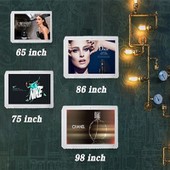


Digital technology has now affected many industries, and the catering industry is no exception. The traditional blackboard can no longer adapt to the current development direction. Based on this situation, the food truck digital menu board has emerged. It not only innovates the traditional menu model, but also brings more possibilities to operators.
How to choose the right digital signage menu board for your food truck
There are many styles of digital signage menu boards, and choosing a suitable menu board can bring you more help. Here are some common considerations.
Screen size
The space of a food truck is generally very limited, and the menu board is usually installed on the outside of the truck, so it is very important to choose a digital menu board of the right size. Generally speaking, small food trucks can consider 18 to 22-inch digital signs, which can display menu information well without taking up too much space. Medium-sized food trucks can use 24 to 32-inch screens, which can display pictures of dishes in more detail and classify them. Large food trucks can use a combination of multiple screens to create a menu display wall with visual impact to attract customers.
Brightness
Since most food trucks are used in mobile scenarios, and generally speaking, they are most often used outdoors, so the demand for brightness will be higher. Unless you fix the food truck in an indoor scene, it would be more appropriate to choose a high-brightness digital signage. No matter how bright the light is, it can ensure that the screen content is clearly visible, allowing customers to easily browse the menu.
Power supply requirements
Considering that the power supply stability of a dining car may not be as stable as that of a fixed location, the power supply design of the digital menu board should be reasonable. On the one hand, the menu board should have multiple power supply methods, such as being able to directly connect to the dining car's 12V - 24V DC power supply, or being able to adapt to 220V AC power supply through a converter to cope with the electrical systems of different dining cars. On the other hand, the power consumption of the digital food menu board should be low. Under the premise of ensuring normal display effects, the power consumption is preferably controlled between 50 - 100 watts, which can not only reduce the burden on the dining car's power supply system, but also reduce operating costs.
Content update method
Efficient and convenient content update method can greatly improve the flexibility of food truck operation. Choosing a digital menu that supports content update via USB or wifi can reduce most of your troubles. Through real-time update, the menu can be updated within a few minutes, which can quickly respond to market changes.
Why deploy digital menus on food trucks?
Improve customer experience
Intelligent digital menu boards can present menu information in an intuitive and vivid way, bringing customers a new ordering experience. They can display the production process of dishes through various dynamic media to stimulate customers' appetite. For example, a food truck that specializes in hamburgers can play a complete video of the hamburger process from bread baking, patty frying to vegetable matching and assembly, so that customers can taste the delicious hamburger in advance, thereby effectively shortening the customer's ordering decision time and improving customer satisfaction.
More attractive
Compared with traditional paper menus, digital menus can more easily attract the attention of passers-by. Operators can use unique visual effects to create personalized menu displays, such as displaying the story of the food truck and customer feedback, to achieve differentiation and achieve their own unique effect.
Support real-time menu updates
The menu of a restaurant needs to be adjusted based on factors such as the cost of ingredients, the availability of suppliers, and customer taste preferences. The advantage of a digital menu board is that it has the ability to update in real time. Operators can quickly modify the price of dishes, remove out-of-stock dishes, or introduce new product recommendations based on real-time data. During holidays, special events, or promotional periods, a simple operation in the background can complete the switching of theme menus in a short time.
Conclusion
As a key step in the digital upgrade of dining cars, digital menu boards have brought unprecedented opportunities for change to the dining car industry, from carefully selecting menu boards that meet the characteristics of their own dining cars to fully tapping their huge potential in improving customer experience, enhancing brand appeal, and achieving real-time menu updates. In the future competition in the dining car market, dining cars that are good at using the advantages of digital menu boards will definitely stand out more in the dining car market.